
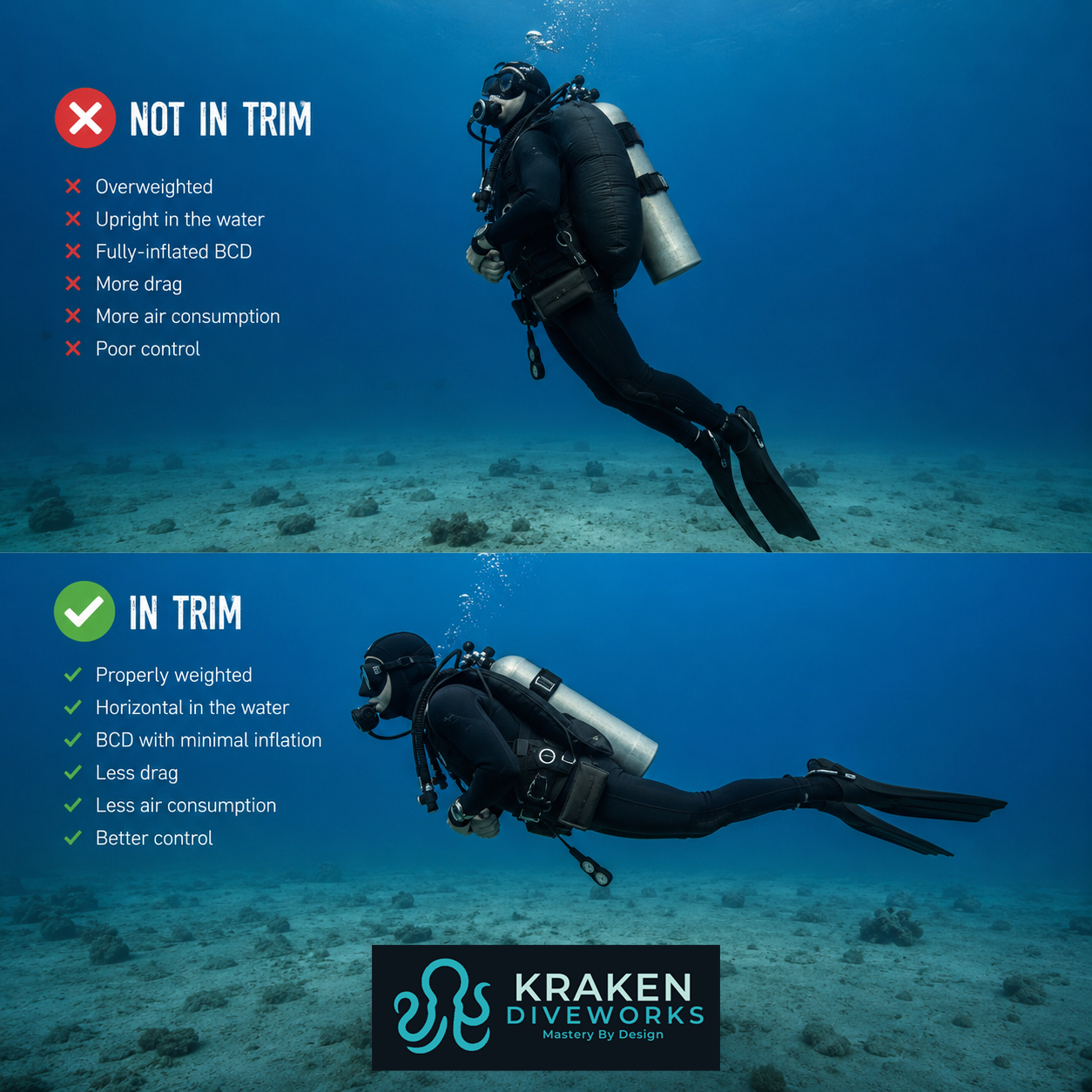
Over-weighting isn’t a beginner problem. It’s an everyone problem.
Walk any dive boat and count the BCD inflators being held open during descent. That’s not a buoyancy technique. That’s a symptom.
Over-weighting is the single most common error we see in experienced recreational divers — and it cascades into almost every other problem in the water.
What Excess Lead Actually Does to Your Dive
- Forces you to add air to your BCD to compensate — now you have a dynamic buoyancy system that surges up and down instead of a diver in control of their depth
- Kills your trim — weight distributed wrong (or in too much quantity) pulls your hips and legs down, putting you in a head-up angle that increases drag and destroys propulsion efficiency
- Inflates your air consumption — fighting to maintain depth burns gas. A properly weighted diver in good trim uses dramatically less gas than an over-weighted diver on the same dive.
- Creates real risk at the end of the dive — at low tank pressure your cylinder becomes positively buoyant. If you’re carrying too much lead, you may not have enough BCD lift to compensate on ascent with a nearly empty tank.
The Weight Check Standard We Use
At the surface, fully deflated BCD, nearly empty tank, holding a normal breath — you should float at eye level. Exhale fully and you should begin to sink slowly. If you’re sinking with air in your BCD, you’re over-weighted. If you are performing the test with a full cylinder, add about 5lbs of weight after the test to compensate for the added buoyancy of the tank when empty. (The weight of the compressed gas in a full cylinder is about 5-6lbs)
Run this check in a pool or shallow water before your next open-water dive. Adjust until the math works. Then relearn your buoyancy from a proper baseline.
This is one of the first things we address in our Advanced Diver Development course — because everything else builds on it.
Kraken DiveWorks | Newington, CT
Leave a Reply